
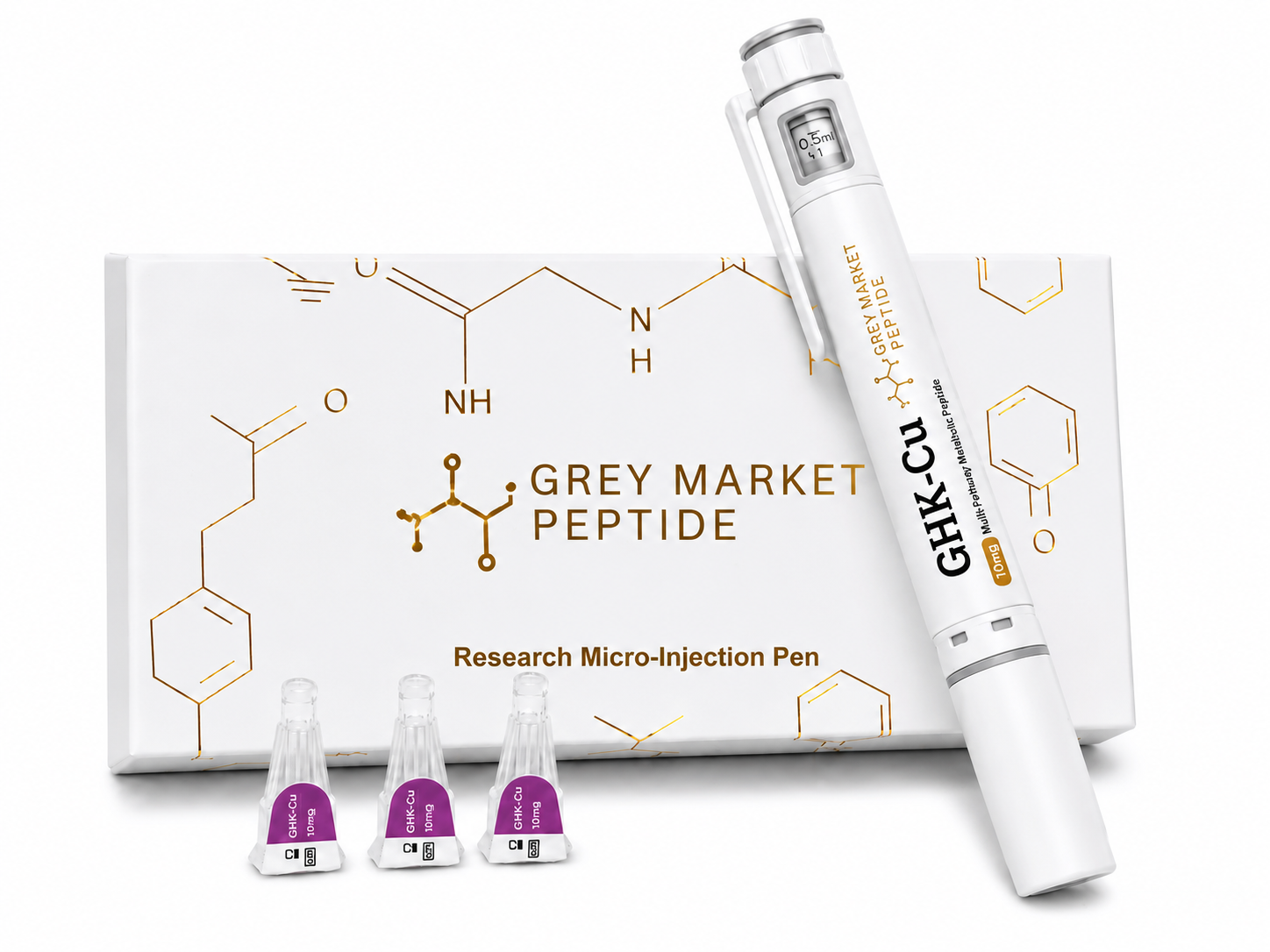
GHK-CU Pre-Filled Micro-Injector
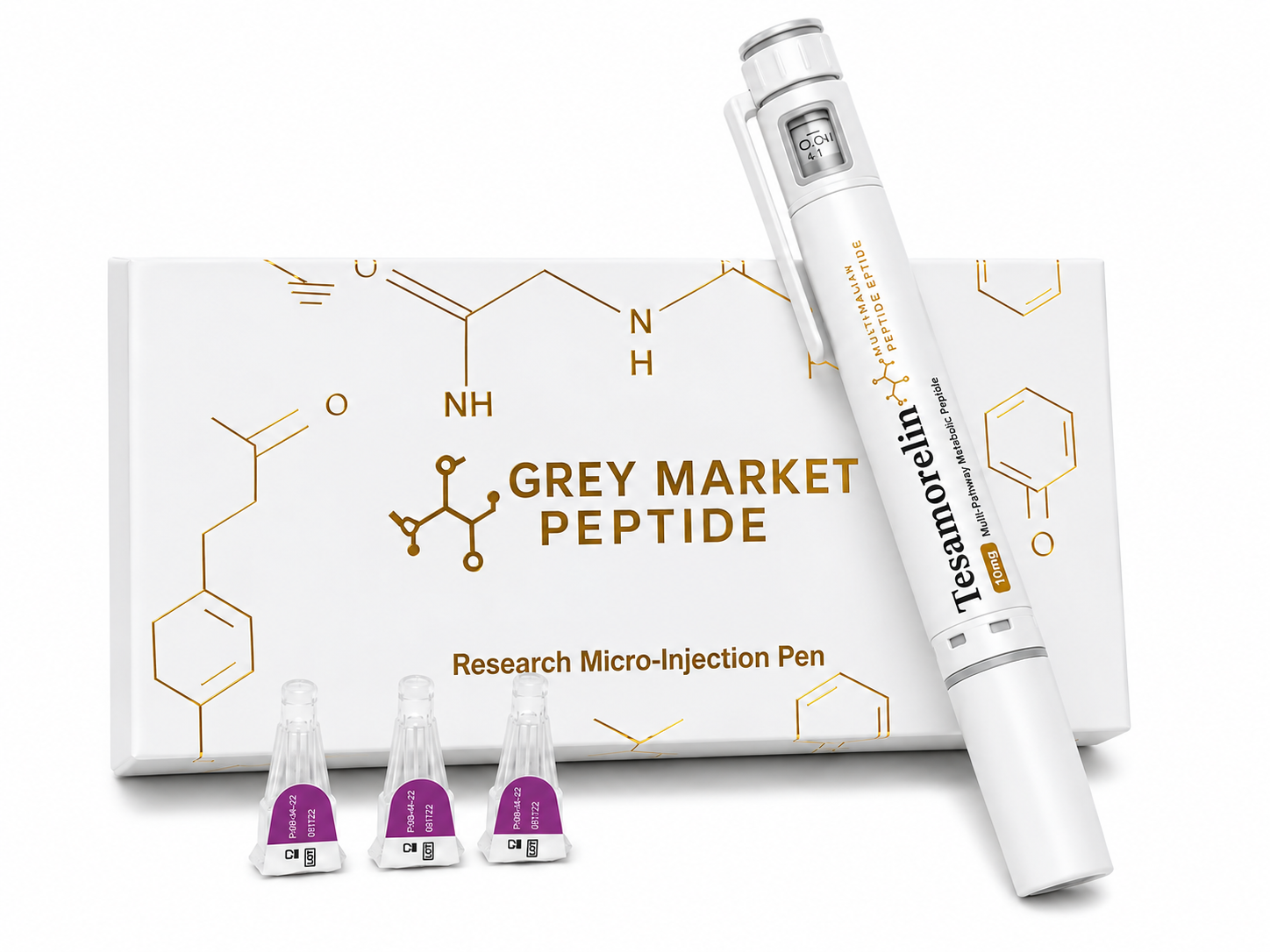
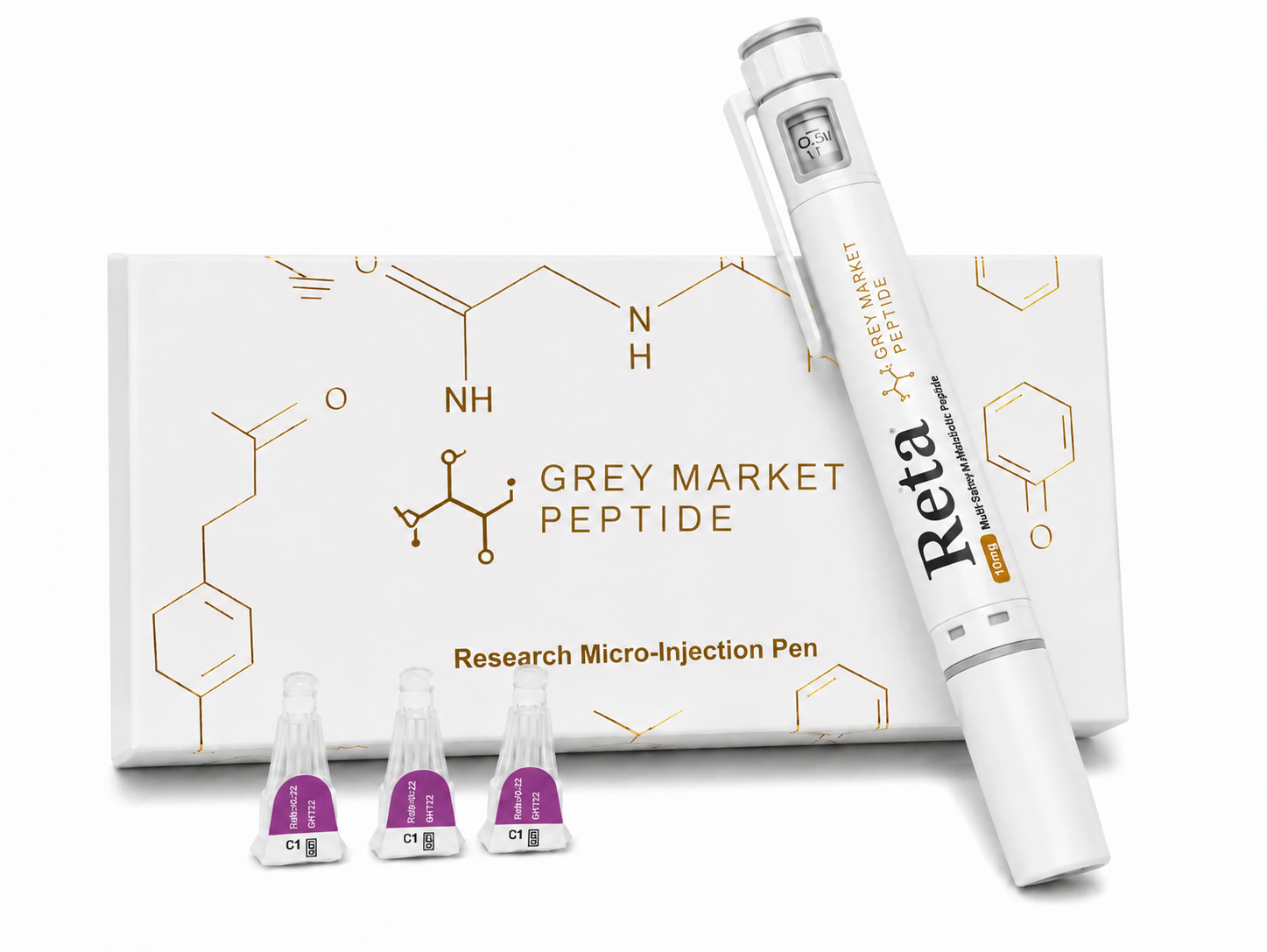
Price range: $121.50 through $466.00
Product Disclaimer
Manufactured in a GMP-compliant ISO 9001:2008 facility and guaranteed ≥ 99% purity; each batch is fully analysed to ensure quality.
All batches are free of LPS.
Usage: This product is intended strictly as a research chemical and is limited to scientific research and education only.
This product is not a drug, food, or cosmetic and may not be misbranded, misused, or mislabeled as a drug, food, or cosmetic.
By completing your purchase, you acknowledge that GHK-Cu (Copper Peptide, 50mg) is an investigational material not approved for general medical or therapeutic use by any regulatory authority.
You assume full responsibility for proper handling, storage, and use in accordance with all applicable laws and regulations.
No claims are made regarding safety, efficacy, or intended use outside of a controlled research environment.
Technical Specifications
| Synonyms | GHK-Cu; Copper Tripeptide-1 |
|---|---|
| Chemical Formula | C₁₄H₂₄N₆O₄Cu |
| CAS Number | 49557-75-7 |
| Molecular Weight | Approx. 403.9 g/mol |
| Peptide Length | 3 amino acids |
| Purity | ≥99.0% (validated by Certificate of Analysis) |
| Appearance | Blue to blue-green lyophilized powder |
| Solubility | Fully soluble in water (H₂O) |
| Quality Verification | Confirmed by RP-HPLC analysis |
| Storage Conditions | Store dry at 2–8 °C; protect from light; |
Lyophilised Powder: Stable at room temperature (20°C–25°C) for up to 90 days during shipping. For optimal long-term integrity, store in a laboratory freezer at -20°C.
Reconstituted Solution: Once reconstituted with bacteriostatic water, store refrigerated between 2°C and 8°C. Do not freeze reconstituted solutions. Avoid repeated freeze-thaw cycles and protect from direct exposure to light.
GHK-Cu Peptide Injection Buy Online: Research Guide
If you are searching for GHK-Cu peptide injection buy online, it is important to understand what GHK-Cu is, what research has investigated, and why injectable products require considerably more caution than topical copper-peptide products.
GHK-Cu is commonly known as a copper-binding peptide and is also referred to as copper tripeptide-1. It has attracted research interest because of its interaction with copper and its biological activity in laboratory and experimental settings.
Online searches for GHK-Cu peptide injection, GHK Cu peptide injections near me, and GHK-Cu peptide injection before and after often combine research interest with cosmetic and wellness claims. These subjects should be considered separately.
Most importantly, evidence involving topical or laboratory GHK-Cu should not automatically be treated as evidence that an injectable GHK-Cu product is safe or effective for human use.
What Is GHK-Cu?
GHK-Cu is a naturally occurring copper-binding peptide commonly identified as glycyl-L-histidyl-L-lysine copper complex.
The peptide has attracted scientific interest because copper is involved in numerous biological processes and GHK-Cu can bind copper ions.
GHK-Cu research has examined areas including:
- Copper-peptide biology
- Cellular signaling
- Tissue research
- Skin-related research
- Wound-healing models
- Extracellular matrix research
- Peptide chemistry
However, research interest does not automatically establish a particular medical or cosmetic use.
This distinction becomes especially important when searching for GHK-Cu peptide injection buy online, because an injectable formulation introduces additional considerations involving sterility, formulation, impurities and administration.
What Is a GHK-Cu Peptide Injection?
A GHK-Cu peptide injection refers to a formulation intended to deliver GHK-Cu through an injectable route.
This is different from a topical cosmetic containing copper tripeptide-1.
The route of administration matters because an injectable product bypasses some of the body’s natural barriers. Consequently, product quality and manufacturing controls become particularly important.
A research compound should not be assumed to have the same safety profile when administered by injection as when used in a laboratory model or topical formulation.
GHK-Cu Peptide Injection Research
GHK-Cu has been the subject of scientific research for many years, but the evidence base is not equivalent to that of an established FDA-approved injectable medicine.
The FDA currently identifies GHK-Cu for injectable routes of administration among bulk substances associated with potential safety concerns. The agency specifically notes potential immunogenicity related to peptide aggregation and peptide-related impurities and states that there are limited human data available to inform safety considerations.
This is an important consideration for anyone researching injectable GHK-Cu.
A product being advertised online does not mean that the product has been evaluated by regulators for safety, effectiveness, sterility or manufacturing quality.
GHK-Cu Peptide Benefits: What Does Research Actually Tell Us?
GHK-Cu is frequently associated online with claims involving skin appearance, collagen, tissue repair and other biological effects.
Some of these subjects have been investigated in scientific and laboratory research. However, it is important to distinguish:
- Laboratory findings
- Cell or animal research
- Topical cosmetic research
- Human clinical research
- Injectable human research
These categories should not be treated as interchangeable.
For example, evidence involving GHK-Cu in a laboratory or topical setting does not automatically establish that injecting GHK-Cu produces the same effect.
For an SEO page targeting GHK-Cu peptide injection, this distinction improves both accuracy and credibility.
GHK-Cu Peptide Injection Before and After
The search “GHK-Cu peptide injection before and after” suggests that many people are looking for visual evidence of results.
Before-and-after photographs can sometimes be useful for documenting changes, but they do not by themselves establish that GHK-Cu caused the change.
Images can be affected by:
- Lighting
- Camera settings
- Skin hydration
- Facial expression
- Angle
- Makeup
- Age
- Time between photographs
- Other skincare products
- Other treatments
- Natural changes over time
Consequently, a before-and-after photograph should not be treated as clinical evidence.
What should you look for in before-and-after claims?
When evaluating online claims, consider whether the information provides:
- A clearly documented timeframe
- Consistent photography conditions
- Information about other treatments
- A defined study population
- Appropriate controls
- Objective measurements
- Published research supporting the claim
A single photograph cannot establish the safety or effectiveness of an injectable peptide.
GHK-Cu Injections Near Me
Another common search is “GHK Cu peptide injections near me.”
People using this search may be looking for a clinic, healthcare professional or provider offering an injectable peptide service.
Because injectable products can carry risks associated with contamination, sterility, formulation and administration, consumers should verify the credentials and regulatory status of any provider rather than choosing a provider solely because it appears prominently in search results.
When considering an injectable product or service, questions may include:
- Is the provider appropriately licensed?
- Is the product legally supplied?
- Who manufactures or compounds the product?
- Is the product intended for human use?
- What quality controls apply?
- Is there appropriate product documentation?
- What regulatory authority oversees the provider?
- Has a qualified healthcare professional assessed whether the product is appropriate?
These questions are more meaningful than simply searching for the lowest online price.
Buying GHK-Cu Peptide Online
Searches for GHK-Cu peptide injection buy online can return products from a variety of websites, including research-chemical suppliers, cosmetic sellers, peptide vendors and compounding-related businesses.
The word “research” on a website does not by itself establish that a product is safe for human administration.
The FDA has specifically warned that products marketed as “research use only” can still be considered drugs when the surrounding marketing demonstrates an intended human use. In a 2026 warning letter involving peptide products, the FDA emphasized the particular risks associated with injectable products because they can introduce contaminants or microorganisms directly into the body.
Therefore, consumers should carefully distinguish between:
Research material:
A substance supplied for legitimate laboratory research and appropriately labeled for that purpose.
Human medication:
A product legally manufactured, supplied and labeled for human use under the applicable regulatory framework.
These are not necessarily the same thing.
What Makes an Online Peptide Listing More Transparent?
If you are researching GHK-Cu products, transparency is important.
A responsible research listing should clearly identify the compound rather than making vague claims about its contents.
Useful information can include:
- Compound name
- Chemical identity
- Product quantity
- Batch or lot identification
- Available analytical documentation
- Storage information
- Intended research use
- Manufacturer or supplier information
- Applicable regulatory information
Analytical documentation can be particularly useful when evaluating research materials.
However, a certificate of analysis should not be interpreted as proof that a product is approved for injection into humans.
Why Injectable Peptide Quality Matters
Injectable products require a higher level of quality control than many non-sterile research materials.
Potential concerns can include:
- Microbial contamination
- Endotoxin contamination
- Incorrect concentration
- Peptide degradation
- Aggregation
- Peptide-related impurities
- Incorrect labeling
- Inappropriate storage
- Manufacturing problems
The FDA explains that compounded drugs are not FDA-approved and are not reviewed by the agency for safety, effectiveness or quality before marketing. It also notes that poor compounding practices can result in contamination or incorrect amounts of active ingredients.
For that reason, consumers should not assume that an online injectable peptide is safe simply because a website describes it as “high purity.”
GHK-Cu and Regulatory Status
Regulatory status is an important part of researching GHK-Cu.
In its current information concerning bulk substances used in compounding, the FDA identifies injectable GHK-Cu as raising safety considerations related to potential immunogenicity, aggregation and peptide-related impurities. The agency also notes limited human data for injectable GHK-Cu.
The FDA’s April 2026 update also states that GHK-Cu for injectable routes was removed from a particular Category 2 listing because nominations were withdrawn, while noting that FDA intended to consult its Pharmacy Compounding Advisory Committee regarding potential inclusion of GHK-Cu on the 503A bulk list.
This illustrates why regulatory status should be checked against current official information rather than relying on claims made by an online seller.
Regulations can also differ between countries.
GHK-Cu Topical vs Injectable
An important distinction is the difference between topical GHK-Cu products and injectable GHK-Cu.
| Consideration | Topical GHK-Cu | Injectable GHK-Cu |
|---|---|---|
| Route | Applied to skin | Delivered through injection |
| Product considerations | Cosmetic formulation and skin compatibility | Sterility, formulation, impurities and administration |
| Research evidence | Includes topical/cosmetic research | Human safety information is limited |
| Regulatory considerations | Depends on formulation and claims | Additional regulatory and safety considerations |
| Risk considerations | Product-specific | Greater concern because product enters the body |
Evidence from one route should not automatically be transferred to another.
Should You Trust GHK-Cu Before-and-After Photos?
Before-and-after images can be useful as illustrative material, but they should not be treated as proof of a product’s effectiveness.
For a scientifically meaningful conclusion, researchers generally need more than photographs.
Useful evidence may include:
- A defined study protocol
- A suitable number of participants
- Appropriate controls
- Objective outcome measurements
- Transparent methodology
- Statistical analysis
- Published results
This is particularly important when a website makes claims about injectable GHK-Cu.
Frequently Asked Questions
What is GHK-Cu?
GHK-Cu is a copper-binding peptide also known as copper tripeptide-1. It has been investigated in several areas of biological and peptide research.
What is a GHK-Cu peptide injection?
It is a formulation intended to deliver GHK-Cu through an injectable route. Injectable GHK-Cu requires additional consideration regarding formulation, sterility, impurities and regulatory status.
Can I buy GHK-Cu peptide injection online?
Online listings exist, but availability does not establish that a product is approved, safe or appropriate for human injection. Regulatory requirements vary by jurisdiction. Anyone considering an injectable product should verify its legal status and consult an appropriately qualified healthcare professional.
What are people searching for when they say “GHK Cu peptide injections near me”?
This search commonly indicates interest in finding a local provider offering GHK-Cu injections. Provider credentials, product sourcing and applicable regulations should be verified before considering an injectable service.
What does “GHK-Cu peptide injection before and after” mean?
It generally refers to photographs or other comparisons intended to demonstrate changes following use. Such images alone cannot establish causation, safety or clinical effectiveness.
Is injectable GHK-Cu FDA approved?
The FDA’s current information identifies injectable GHK-Cu as having important safety considerations and limited human safety data. Consumers should not assume that an online injectable GHK-Cu product is FDA-approved.
Is GHK-Cu the same as copper tripeptide-1?
GHK-Cu is commonly referred to as copper tripeptide-1, reflecting the peptide’s association with copper.
Is topical GHK-Cu the same as injectable GHK-Cu?
No. The route of administration is different, and evidence for topical products cannot automatically be applied to injectable formulations.
Final Thoughts on GHK-Cu Peptide Injection
The keyword GHK-Cu peptide injection buy online combines commercial search intent with significant informational intent. A useful page should therefore provide more than a simple product description.
GHK-Cu is a copper-binding peptide with a substantial history of scientific interest. However, injectable GHK-Cu requires particular caution. The FDA identifies potential concerns involving immunogenicity, peptide aggregation and peptide-related impurities and notes that human safety information for injectable GHK-Cu is limited.
People searching for GHK Cu peptide injections near me or GHK-Cu peptide injection before and after should therefore evaluate provider credentials, product documentation, regulatory status and the quality of the evidence behind any claims.
For Grey Peptide Market, the strongest long-term SEO strategy is to position this page as a comprehensive GHK-Cu research resource, rather than relying on repeated exact-match keywords or unsupported promises.
That approach allows the page to address commercial, informational and comparison searches while maintaining accurate research-focused content.
| BUNDLE & SAVE | Buy 1, Buy 2, Buy 3, Buy 4+ |
|---|---|
| MG | 50mg |
Reviews
There are no reviews yet.
Related products
peptide pens
peptide pens
peptide pens
peptide pens
peptide pens
peptide pens
peptide pens
Be the first to review “GHK-CU Pre-Filled Micro-Injector”