
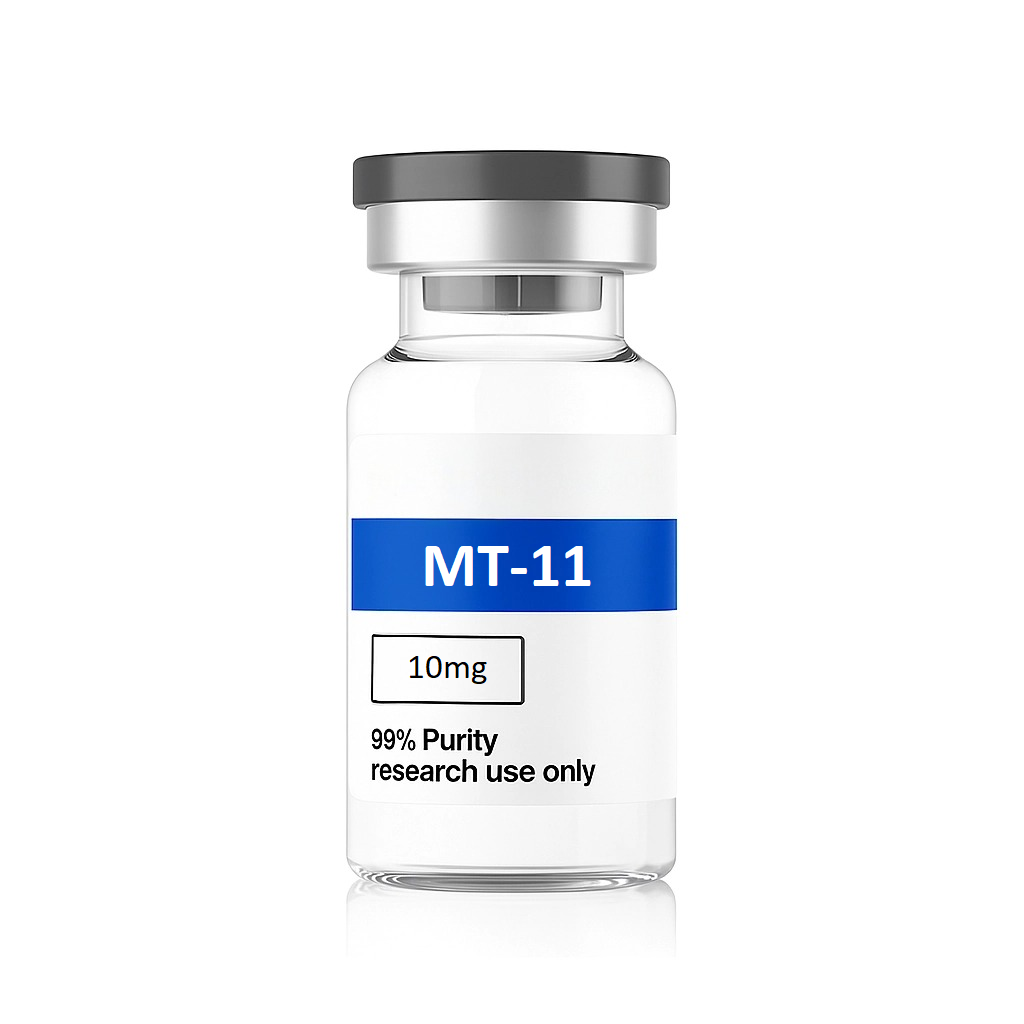




MT 2 Peptide (Melanotan 2) – Research Overview
MT 2 peptide, commonly known as Melanotan 2, Melanotan II, or MT-2, is a synthetic cyclic peptide studied in melanocortin receptor research. It was developed as an analog of alpha-melanocyte-stimulating hormone (α-MSH), an endogenous peptide involved in melanocortin signaling.
Unlike the closely related MT 1 peptide, MT 2 has a compact cyclic structure and interacts with multiple members of the melanocortin receptor family. These characteristics have made Melanotan 2 an important research compound for investigating melanocortin receptor activity and peptide-receptor interactions.
What Is MT 2 Peptide?
MT 2 peptide is a synthetic melanocortin analog designed around the biologically active sequence associated with α-MSH.
It is commonly identified in scientific and research contexts as:
-
MT-2
-
MT-II
-
Melanotan 2
-
Melanotan II
The peptide has a molecular formula of C50H69N15O9 and a molecular weight of approximately 1024.2 g/mol.
Its cyclic architecture is one of the major characteristics distinguishing MT 2 from MT 1 peptide.
How Does Melanotan 2 Work in Research?
Melanotan 2 is studied as a non-selective melanocortin receptor agonist.
Research involving MT-2 has examined its interactions with several melanocortin receptor subtypes, particularly MC1R, MC3R, MC4R, and MC5R.
Because these receptors participate in different biological signaling pathways, MT 2 peptide provides researchers with a model for investigating broader melanocortin receptor activity.
This receptor profile also represents an important difference between Melanotan 1 and Melanotan 2.
Melanotan 1 vs 2: What’s the Difference?
Although their names are similar, Melanotan 1 and Melanotan 2 are distinct peptides and should not be treated as interchangeable compounds.
The MT 1 peptide is a longer, linear analog of α-MSH and has a comparatively MC1R-focused pharmacological profile.
Melanotan 2, on the other hand, is a shorter cyclic peptide associated with broader melanocortin receptor activity.
MT 1 Peptide
Melanotan 1 is generally described as:
-
A linear peptide
-
A 13-amino-acid α-MSH analog
-
More strongly associated with MC1R-focused research
-
Structurally closer to endogenous α-MSH
MT 2 Peptide
Melanotan 2 is characterized as:
-
A cyclic peptide
-
A shorter melanocortin analog
-
An agonist across multiple melanocortin receptors
-
Frequently studied in broader melanocortin signaling research
Therefore, researchers comparing Melanotan 1 vs 2 should consider molecular structure and receptor selectivity rather than assuming that MT-1 and MT-2 are different names for the same peptide.
MT 2 Peptide and Melanocortin Research
The melanocortin system consists of several G-protein-coupled receptors distributed across different tissues.
MT-2 has consequently been investigated as a research tool for examining melanocortin receptor signaling and receptor-ligand interactions.
Its cyclic structure and broad receptor activity make it particularly relevant to laboratory research examining how structural modifications to α-MSH-derived peptides influence receptor affinity and biological signaling.
MT 2 vs MT 1 at a Glance
| Feature | MT 1 Peptide | MT 2 Peptide |
|---|---|---|
| Common Name | Melanotan I | Melanotan II |
| Abbreviation | MT-1 | MT-2 |
| Structure | Linear | Cyclic |
| Peptide Length | 13 residues | 7 residues |
| Approx. Molecular Weight | 1646.8 g/mol | 1024.2 g/mol |
| Receptor Profile | Comparatively MC1R-focused | Broader melanocortin receptor activity |
| Research Context | α-MSH and MC1R research | Broader melanocortin signaling research |
The structural differences between these compounds are important when selecting a peptide for a specific laboratory research model.
Why MT 2 Peptide Is Studied
Researchers use melanocortin analogs to better understand peptide-receptor interactions and the signaling pathways associated with melanocortin receptors.
MT 2 peptide is particularly interesting because cyclization produces a structurally constrained molecule compared with linear α-MSH analogs.
Research involving Melanotan 2 may therefore contribute to studies examining receptor binding, melanocortin signaling, peptide structure, and structure-activity relationships.
Frequently Asked Questions About MT 2 Peptide
What is MT 2 peptide?
MT 2 peptide, or Melanotan 2, is a synthetic cyclic melanocortin peptide derived from research involving alpha-melanocyte-stimulating hormone (α-MSH).
Is MT 2 the same as Melanotan 2?
Yes. MT 2, MT-2, MT-II, Melanotan 2, and Melanotan II are commonly used names for the same research compound.
What is the difference between Melanotan 1 and 2?
The primary differences involve molecular structure and receptor activity. Melanotan 1 is a longer linear peptide with a comparatively MC1R-focused profile, whereas Melanotan 2 is a shorter cyclic peptide that interacts more broadly with melanocortin receptors.
Is MT 1 peptide the same as MT 2 peptide?
No. Although both originated from α-MSH-related research, MT 1 peptide and MT 2 peptide are structurally and pharmacologically distinct compounds.
What receptors are associated with Melanotan 2 research?
Published research describes MT-2 as interacting with several melanocortin receptor subtypes, including MC1R, MC3R, MC4R, and MC5R.
Is Melanotan 2 FDA approved?
Melanotan 2 is not FDA approved for human use. Research material should not be represented as an FDA-approved treatment or medicine.
MT 2 Peptide for Research
MT 2 peptide remains a notable compound in melanocortin research because its cyclic structure and broad receptor profile differentiate it from linear α-MSH analogs such as MT-1.
For researchers investigating Melanotan 1 vs 2, understanding these structural and receptor-level differences provides a stronger scientific basis for distinguishing the two compounds.
Research Use Notice: MT 2 peptide products offered for laboratory research should be clearly labeled for research purposes only and not represented as approved for human consumption, therapeutic use, or medical treatment.
Reviews
There are no reviews yet.
Related products

peptide

peptide

peptide
peptide
peptide
Be the first to review “MT- 11 (Melanotide)”